For any hospitality venue with outdoor seating , a pub beer garden, a rooftop bar, a waterfront restaurant, a café with a terrace , summer is simultaneously the busiest season and the one that most reliably turns paying customers away. When ambient temperature climbs past a threshold most patrons find uncomfortable, bookings drop, walk-in covers evaporate, and the outdoor section that contributes a significant portion of the venue's capacity sits empty. The business still pays rent on that space, but it generates no revenue.
The question operators are increasingly asking is not whether to invest in outdoor cooling but how to choose the right system and how to model the return before committing. This article works through the revenue problem, the physics of misting cooling, the system options suited to hospitality, and a straightforward ROI calculation you can apply to your own venue's numbers.
The Temperature Threshold Problem
Research into outdoor dining behaviour consistently identifies a threshold above which patron comfort drops sharply. The precise figure varies by study and setting , shading, airflow, humidity and time of day all affect perceived comfort , but the range most commonly cited is 26–28°C effective temperature as the point at which many patrons begin to avoid outdoor seating or shorten their stay.
In Sydney, Melbourne, Brisbane, Adelaide and Perth, this threshold is crossed on a significant number of trading days from November through March. Across a summer trading period, a venue with 60 outdoor covers might effectively lose 30–40 days of full outdoor capacity , not because it rains, but simply because it is too hot to sit outside in comfort.
This is not a marginal problem. It represents a direct, calculable revenue shortfall. And it is exactly the kind of problem a well-specified misting system is designed to solve.
How Misting Extends the Usable Temperature Range
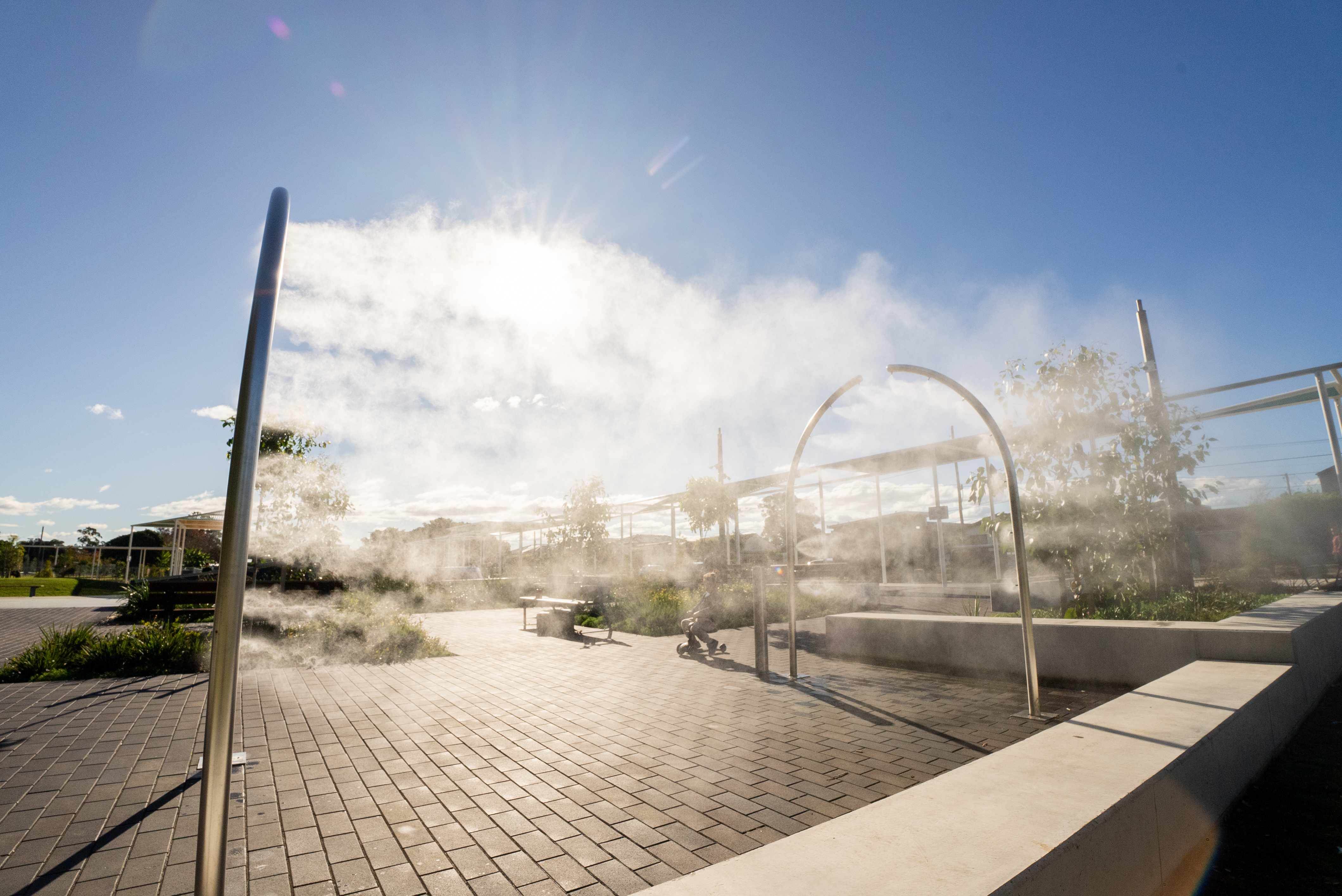
High-pressure misting systems atomise water into droplets small enough , typically 10–20 microns in diameter , that they evaporate before reaching surfaces. As those droplets flash-evaporate, they absorb latent heat energy from the surrounding air. The result is measurable air temperature reduction in the immediate vicinity of the mist discharge.
The scale of the reduction depends on ambient humidity and system design, but in the conditions typical of Australian summer afternoons , low to moderate relative humidity, strong solar load , reductions of 6–12°C in the occupied zone are achievable with a well-designed perimeter or overhead system. In drier inland cities during heatwave conditions, reductions toward the upper end of that range are routinely measured.
Importantly, this cooling is directional and localised. A misting system cools the space where patrons sit, not the surrounding streetscape. Combined with overhead shade, it creates an envelope of manageable temperature that can shift the effective comfort range from 28°C to 38°C or beyond , adding back the trading days and session hours that would otherwise be lost.
Calculating the Revenue Recovery
The ROI case for a hospitality misting system is unusually straightforward because the revenue benefit can be estimated from the venue's own trading data. A simple model:
Step 1: Identify lost outdoor cover days
Review the previous summer's trading data. How many days did the outdoor section operate at less than 50% capacity despite no rain or other event? Cross-reference against BoM temperature records to identify days where the shortfall correlates with temperature. For many Sydney and Brisbane venues, this exercise identifies 25–40 such days across the November–March period.
Step 2: Calculate the cover recovery opportunity
Assume a misting system converts a proportion of those days from low-utilisation to normal outdoor trading. A conservative assumption: the system restores viable outdoor dining on days where ambient temperature is below 38°C (and humidity is not already at the dew point). In most capital cities this captures the majority of heat-driven lost days.
Step 3: Apply average spend per cover
Multiply recovered cover count by average spend per cover. A venue with 60 outdoor seats, an average spend of $65 per cover, and 30 recovered dining sessions across a summer sees a potential revenue uplift of:
60 covers × $65 × 30 sessions = $117,000
Even at 50% cover utilisation across those recovered sessions, the figure is $58,500. Even at a cautious 40% recovery rate , allowing for patrons who simply won't return regardless , the number substantially exceeds the installed cost of a commercial misting system for a venue of that size in a single trading season.
System Types for Hospitality Applications
The right misting system configuration for a hospitality venue depends on the geometry of the space, aesthetic requirements, existing shade structures, and whether the venue wants a seasonal or permanent installation.
Perimeter misting
Nozzles are installed around the perimeter of the dining zone , along fence lines, pergola posts, planter walls , creating a curtain of mist that cools air entering the space. Perimeter systems work well where patrons are seated in an open or semi-enclosed area. They are less effective in very open, windy locations where mist dissipates before reaching the occupied zone.
Overhead misting
Nozzle lines are installed on overhead structures , pergolas, shade sails, awning frames , directing mist downward through the dining zone. Overhead systems deliver more uniform coverage and are less affected by lateral airflow. The critical design requirement is ensuring the nozzle height, droplet size and operating pressure are specified so droplets evaporate before they reach seated patrons or table surfaces , a non-wetting outcome that requires proper engineering, not simply selecting a misting product and attaching it to whatever structure is available.
Fan-assisted misting
Industrial or commercial misting fans combine a centrifugal fan with an integrated misting ring, projecting a column of cooled air into the space. Fan-assisted systems are suited to large, open venues , beer gardens, festival spaces, event terraces , where fixed nozzle installations are impractical. They are also favoured for temporary and event applications where flexibility of placement is important.
Operational Considerations
The difference between a misting system that delivers guest satisfaction and one that generates complaints is largely in how it is operated. Several considerations matter for hospitality specifically:
Automation and trigger settings
Systems should be automated on temperature trigger, not operated manually by staff. Manual operation is inconsistent , systems get left on in cool weather (annoying patrons) or left off in hot weather (defeating the purpose). A temperature sensor at 1.2 m height in the shade , the equivalent of seated head height , activates the system when the occupied zone exceeds the set point and deactivates it when conditions cool. A humidity lockout prevents operation when relative humidity is high enough that mist would not evaporate, which would result in wetting and patron discomfort.
Timer integration
Service period timers ensure the system operates during trading hours only, avoiding unnecessary run time in the early hours of the morning. They also allow programming around specific service periods , lunch service only, or dinner service excluding Sunday nights when the venue is closed.
Aesthetics and integration
Commercial misting systems for hospitality should be installed flush and inconspicuously. Stainless steel tubing, powder-coated line sets matched to structure colour, and recessed fittings create a professional appearance. The system should enhance the guest experience invisibly , patrons should notice the comfort, not the hardware.
Water quality and maintenance
High-pressure misting nozzles are precision-engineered components with orifice diameters of 0.2–0.4 mm. Unfiltered water causes mineral scale accumulation inside the nozzle that reduces flow, alters droplet size, and eventually blocks the nozzle completely. A proper filtration specification , typically sediment pre-filtration plus reverse osmosis , is essential for nozzle longevity and system performance. Annual nozzle inspection and seasonal line flushing are the primary ongoing maintenance requirements.
youmist designs and installs commercial misting systems for beer gardens, rooftop bars, restaurant terraces and event spaces across Australia. We handle hydraulic design, nozzle specification, pump selection, filtration and automation , everything needed to deliver a non-wetting, code-compliant outcome that extends your outdoor trading season.
What to Ask Before Signing a Quote
Not all misting installations are equal. Before accepting a proposal for a hospitality cooling system, verify the following:
- Operating pressure: High-pressure systems (70–100 bar) produce finer droplets than low-pressure systems (3–5 bar). In hospitality, where non-wetting is essential, high-pressure systems are the baseline specification , not an upgrade.
- Filtration specification: Ask what water treatment is included. If the answer is a simple inline sediment filter, the system is not properly specified for hard water areas or long nozzle life.
- Nozzle material and orifice size: Stainless steel anti-drip nozzles are standard for commercial applications. Ask for the orifice specification and the rated droplet size at operating pressure.
- Automation: Is the system controlled by a temperature sensor and humidity lockout, or by a manual switch? Manual systems under-deliver.
- Commissioning and warranty: Does the installer commission and test the system on-site? Is there a parts and labour warranty, and what does the maintenance arrangement look like beyond the warranty period?
A properly specified and commissioned commercial misting system for a medium-sized hospitality venue typically costs in the range of $8,000–$25,000 installed, depending on venue geometry, system complexity and site conditions. Against a conservatively calculated summer revenue uplift of $40,000–$80,000, the payback period is well within a single trading season for venues with meaningful outdoor capacity.
The calculation is clear. The question for most venues is not whether a misting system is worth doing , it is whether to do it before next summer or the one after.