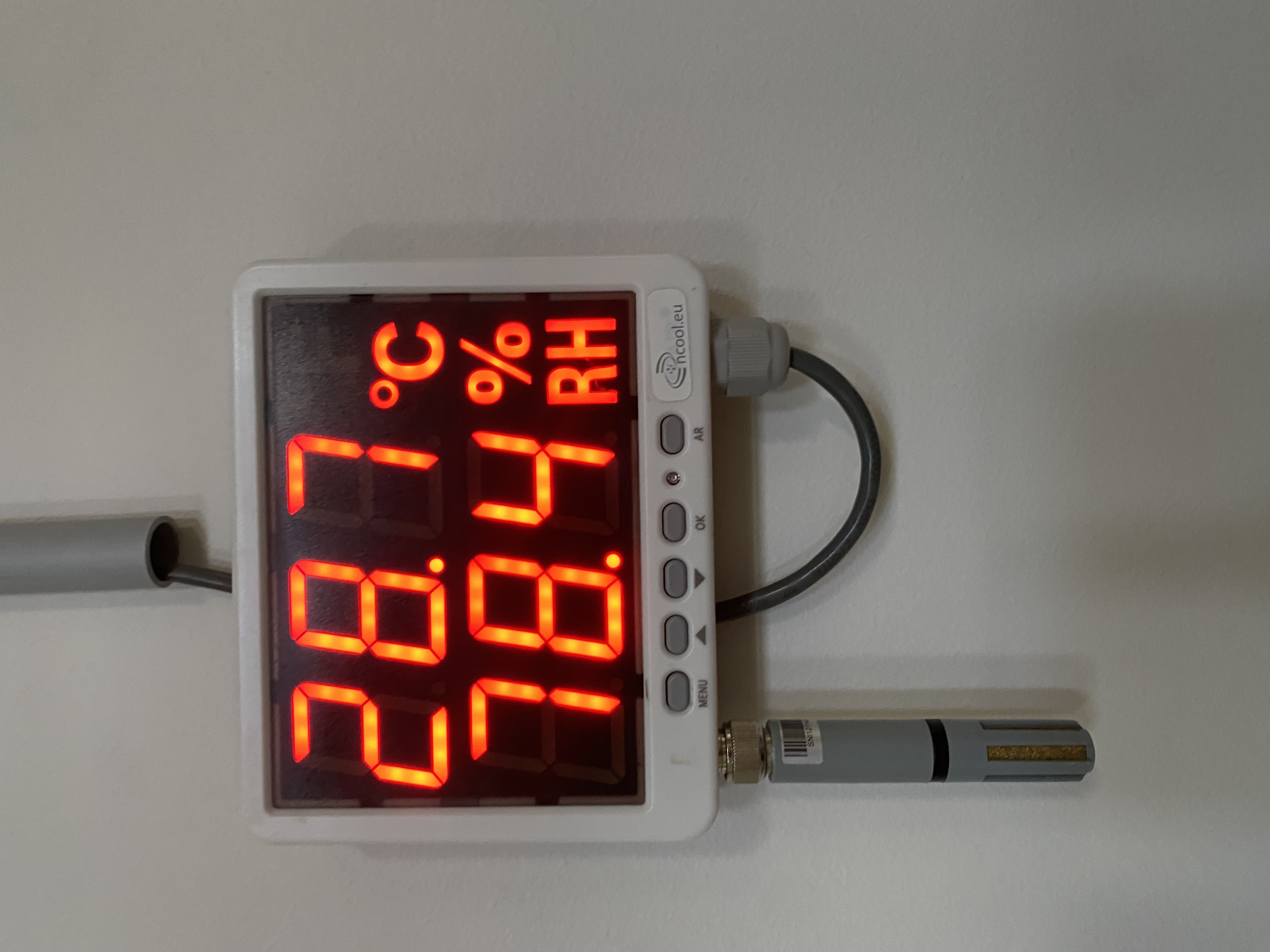
High-pressure atomisation creates droplets under 10 microns that flash-evaporate before reaching any surface — raising relative humidity to your exact target without wetting product, equipment or structure.
When relative humidity drops below 40%, the consequences are immediate and expensive. Paper misfeeds and curls. Timber warps and splits. Static charges build up, attracting dust to sensitive electronics and causing nuisance discharges on production lines. Textile fibres become brittle and break mid-process.
Standard evaporative systems add water in large droplets that settle on surfaces, damaging product and creating slip hazards. Traditional steam humidification is energy-intensive, expensive to run, and can't be targeted to specific zones.
youmist's high-pressure atomising approach solves this differently. At 70 bar, water is forced through precision ceramic nozzles producing a 5–10 micron fog that absorbs into the air before contact with any surface — raising RH where you need it, precisely, without wetting anything.
Every humidification system we install is engineered to your facility's airflow, thermal profile and target RH range — not retrofitted from a catalogue.
We measure your facility's volume, air exchange rate, heat load and current RH baseline. We identify dead zones, high-turnover areas and zones requiring tighter tolerance. This data drives the nozzle layout and pump sizing — not guesswork.
High-pressure stainless lines are routed to nozzle manifolds positioned at ceiling level or within ductwork, matched to airflow direction for maximum absorption distance. Pump units are compact, quiet and mounted in a service area for easy access.
Digital humidistats monitor RH continuously across multiple zones. The control system modulates pump output and valve zones to maintain your target band — typically ±3% RH. Full BMS integration available for facilities with existing building management infrastructure.
We've installed humidification systems across manufacturing, processing and data infrastructure — each one designed around the specific RH requirements and process sensitivities of that site.
Paper is highly hygroscopic. RH fluctuations cause sheet curl, misregistration and static charge events that halt presses and generate waste. We maintain the 45–55% RH envelope that most press manufacturers specify.
Kiln-dried timber will re-absorb or release moisture based on ambient RH. Maintaining a stable environment from the mill floor to the machining bay prevents splitting, warping and dimension change in finished product.
Cold rooms, ripening bays, bakeries and fresh produce facilities rely on precise humidity to maintain product weight, shelf life and texture. Our food-safe stainless systems are designed for washdown environments.
Natural and synthetic fibres become brittle and break in low RH conditions. Humidification extends fibre life, reduces thread breaks on looms and weaving machines, and controls static that attracts lint and contaminates product.
ASHRAE guidelines recommend 45–55% RH in data centre environments. Too dry, and electrostatic discharge can damage hardware. Too humid, and condensation risks corrosion. High-pressure misting delivers precise control without free moisture.
Mushroom fruiting bodies require sustained high humidity — typically 85–95% RH — during pinning and development. Our systems deliver consistent fog across growing room volumes without saturating substrate or creating pooling on floors.
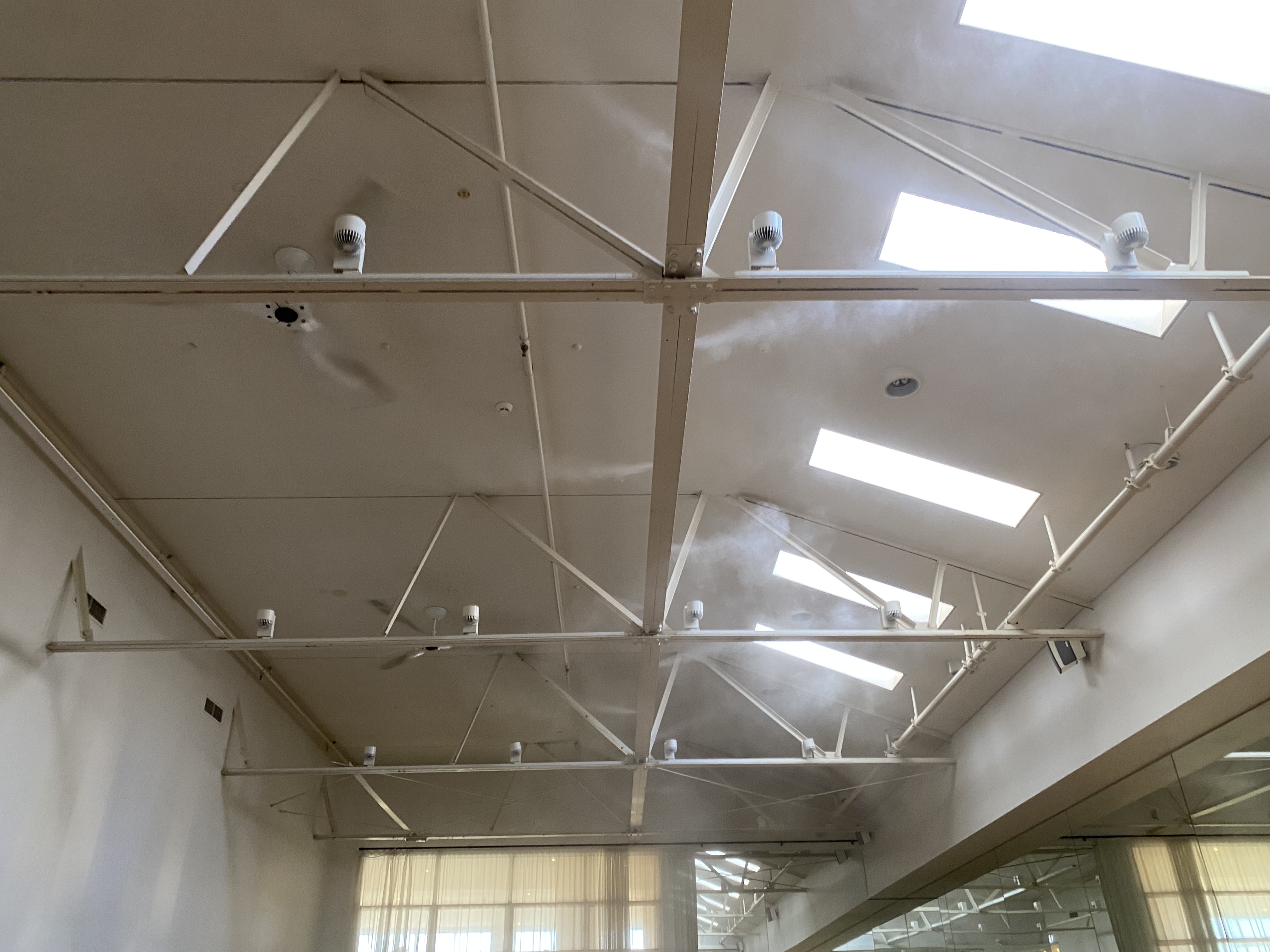
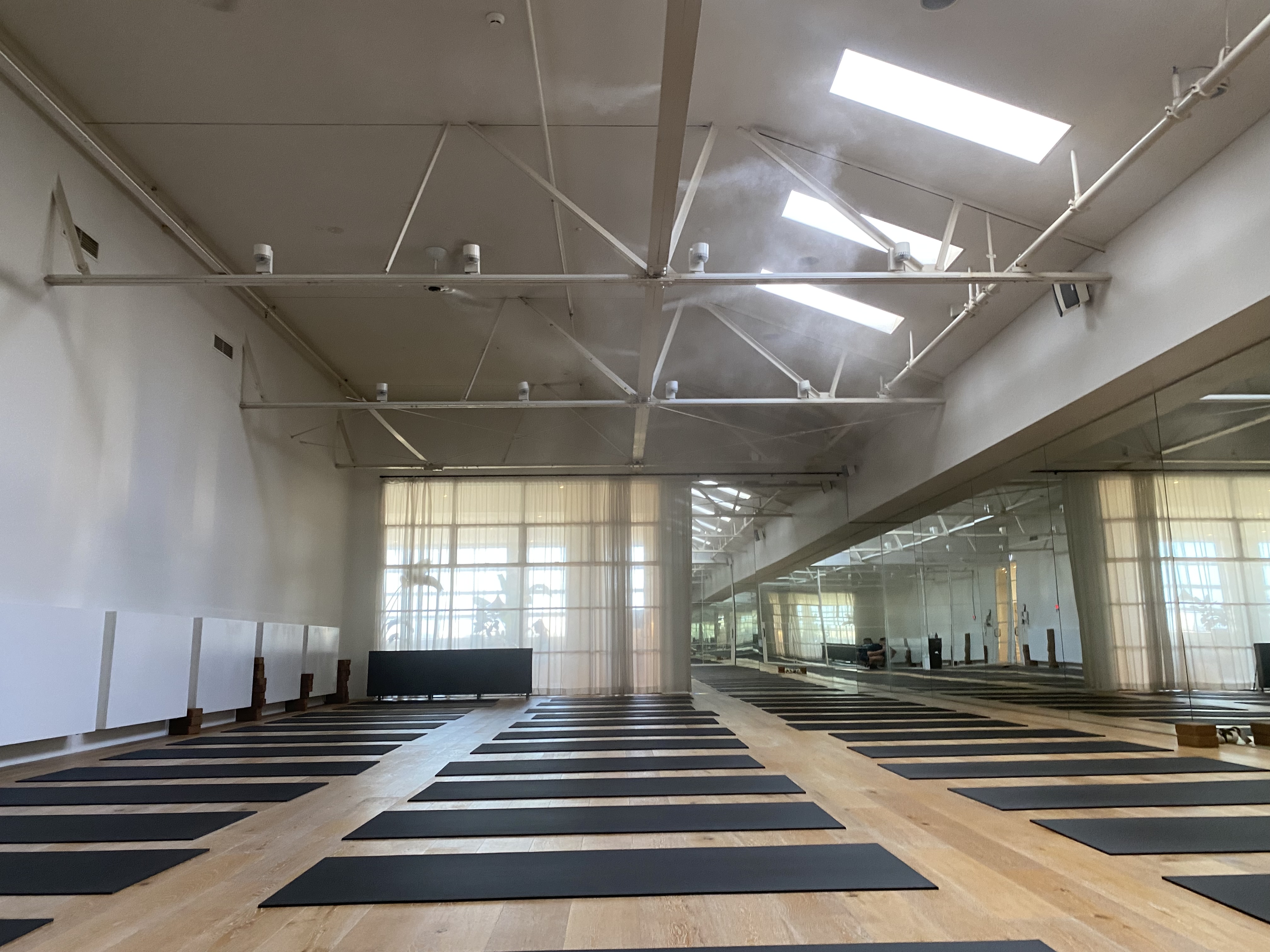
The client needed to sustain above 70% relative humidity throughout every session. The photos speak for themselves — our system delivers and holds that level consistently, class after class.
The critical difference in high-pressure humidification is droplet size. At 70 bar, our ceramic nozzles produce a 5–10 micron fog — below the threshold at which droplets can settle. They absorb into air completely before reaching any surface at distances of 800mm or more.
Pump skids are stainless steel with onboard filtration, expansion vessels and pressure-relief. All wetted components are 316L stainless or EPDM-sealed for food-safe and pharmaceutical environments on request.
Controls range from simple digital humidistats to full BMS integration via Modbus, BACnet or dry-contact relay — matched to what your facility already runs.
No — this is the fundamental advantage of high-pressure atomisation. At 70 bar, nozzles produce droplets of 5–10 microns which flash-evaporate before they can settle on any surface. Provided nozzles are positioned with adequate absorption distance (typically 800mm+ from any surface in still air), no wetting occurs. We confirm this during commissioning.
Yes. We integrate with Modbus RTU/TCP, BACnet IP/MSTP and dry-contact relay — the protocols used by most Siemens, Johnson Controls, Schneider and Honeywell building management systems. We can also expose RH zone data as a feed into your SCADA or DCIM platform. Speak to us during the site assessment and we'll confirm compatibility.
We recommend softened or reverse osmosis (RO) treated water for most applications. Hard water will cause mineral scaling in nozzles and leave white residue if any droplets do reach a surface. For food processing and pharmaceutical environments, RO is mandatory. We can supply RO pre-treatment as part of the system package or tie into an existing RO supply.
High-pressure humidification is significantly more energy efficient than steam humidification — typically 90% less energy per kilogram of water evaporated. A pump unit serving a 500m² pressroom uses roughly the same power as a domestic washing machine. Water consumption varies by target RH, ambient conditions and ventilation rate — we provide an operating cost estimate as part of the design proposal.
Annual maintenance includes nozzle inspection and replacement (nozzles are ceramic-tipped and long-lasting but degrade over time), pump service, filter cartridge replacement and humidistat calibration check. We offer annual SLA contracts that include all labour and consumables for a fixed annual cost. Most facilities require 4–6 hours of service per year.
Share your facility type, floor area and current humidity problems. We'll respond with a preliminary design approach and site assessment proposal — typically within one business day.