Misting systems appear with increasing frequency in public realm project briefs , playgrounds, park precincts, town centres, waterfront promenades and civic squares. They are specified for cooling, for activation, for visual effect, and sometimes for all three simultaneously. But the gap between a brief that says "incorporate misting" and a specification that delivers a working, maintainable, code-compliant installation is where most problems arise.
This guide is written for landscape architects who are at the point in a project where misting needs to move from a design intent to a documented specification. It covers when to involve the misting designer, what flush-mount systems require from a civil coordination perspective, what the hydraulic specification must include, and the most common errors that cause problems at tender stage and beyond.
When to Involve the Misting Designer
The single most consequential decision in misting specification is when you bring the misting designer into the project. Late involvement , at documentation stage, after civil and structural elements are fixed , is the primary source of cost overruns, design compromises and installation problems in public realm misting projects.
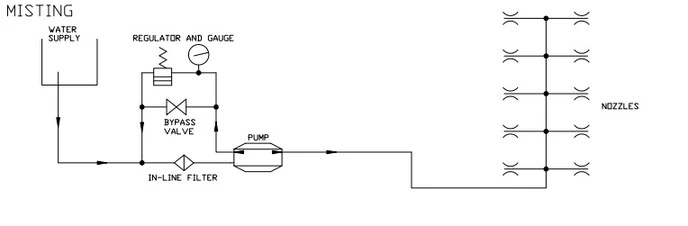
Misting systems have significant hydraulic demands. A typical flush-mount ground fog installation requires a high-pressure pump unit that must be housed in a plant room or pit, connected to the nozzle array via high-pressure stainless steel tubing routed through the pavement structure. The pump requires water supply, power supply (typically three-phase), and drainage. The nozzle array requires precise sleeve locations cast into the pavement slab. None of these can be easily retrofitted after the slab is poured.
Bring the misting designer in at concept design stage , at the same time as civil, structural and electrical. An early conversation about hydraulic constraints, nozzle layout and plant room requirements will prevent the most common and costly problems.
Flush-Mount vs Perimeter Systems
The two primary installation types for public realm misting have different design implications:
Flush-mount (ground fog) systems
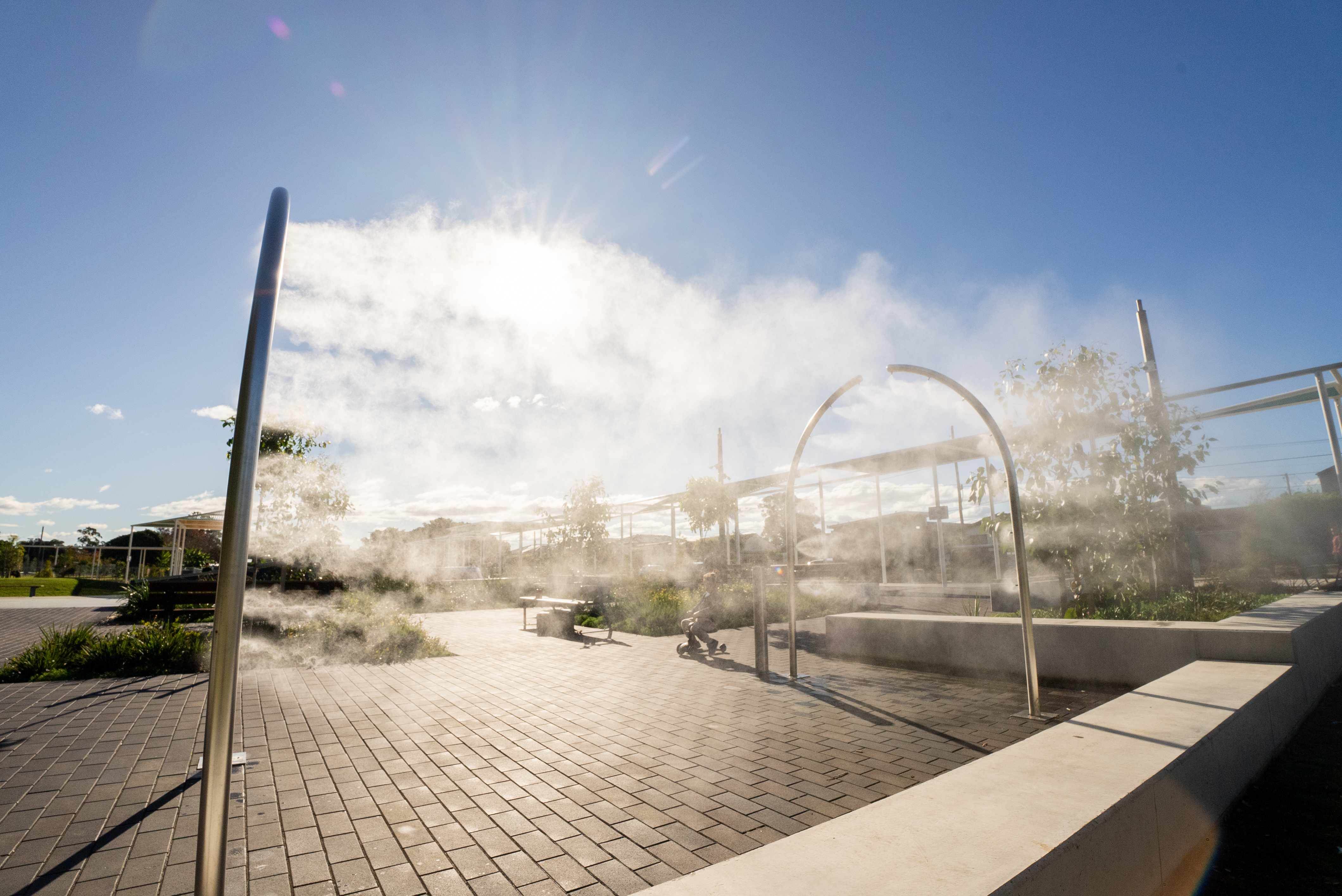
Nozzles are set flush with the paved surface , typically in a purpose-designed stainless steel body installed in a sleeve cast into the slab. The effect is mist rising from the ground, which is visually distinctive and removes any above-ground hardware footprint. These systems require:
- Sleeve locations cast into the concrete or pavement slab , cannot be core-drilled after the fact
- High-pressure tubing routed below the slab , requires conduit to be cast in at the time of the pour
- Drainage at each nozzle location to manage anti-drip release and cleaning cycles
- A plant room or pit accessible for pump maintenance within a reasonable distance of the array
Perimeter systems
Nozzles are attached to fixed structures , pergolas, shade structures, handrails, purpose-designed brackets , at a height that creates a curtain of mist around the perimeter of a space. These systems are more flexible than flush-mount in terms of installation timing, but they introduce above-ground hardware that must be designed into the architectural and landscape language of the space.
What the Hydraulic Specification Must Include
A misting system specification that will actually produce competitive, comparable tenders requires more than a product description. The hydraulic specification must include:
- Operating pressure: Specify the system operating pressure (typically 50–70 bar for high-pressure systems) rather than leaving it to the contractor to determine.
- Nozzle flow rate and spacing: Define the nozzle orifice size and spacing based on the coverage zone, not just a nozzle count. Spacing affects coverage density and water consumption.
- Filtration requirement: Specify reverse osmosis (RO) filtration as a minimum. Without this, mineral scale will block nozzles within weeks of operation.
- Water supply: Define the minimum water supply pressure and flow rate at the point of connection. Inadequate supply pressure is a common source of system underperformance.
- Pump unit location: Define the maximum distance from pump to furthest nozzle, which determines the hydraulic design requirements for pipe sizing.
Coordination with Civil, Structural and Electrical
For flush-mount installations, the following coordination items must be resolved before the civil documentation is issued for construction:
- Sleeve locations: Exact X-Y coordinates of each nozzle sleeve, confirmed by the misting designer and reflected in the civil drawing set.
- Conduit routing: High-pressure tube conduit routing below the slab, confirmed by the structural engineer and shown on the civil construction drawings.
- Pit details: Plant room or pit structural details, including waterproofing specification, access cover type and load rating for in-ground installations.
- Drainage: Drainage provision at each nozzle location and at the plant room.
- Power supply: Electrical supply to the pump , typically three-phase 15A with an isolator within sight of the pump. Confirm with the electrical engineer.
- BMS integration: If the project includes a building management system, confirm integration requirements for temperature-triggered operation.
DA Documentation Considerations
In most NSW local government areas, misting systems in public spaces are covered by the principal development consent for the public domain works , they do not require a separate DA. However, the development consent conditions may impose requirements that affect system design:
- Water consumption limits or connection to recycled water supply
- Restrictions on above-ground structures in certain heritage or view corridors
- Requirements for public liability documentation and maintenance plans
Confirm with the council's development assessment team early whether any DA conditions apply to the misting system specifically.
Common Specification Errors
The errors that most frequently cause problems at tender stage and beyond:
- Undersized pump specification , specifying a pump by motor kilowatt rating without defining the required operating pressure and flow rate. This results in non-comparable tenders and, often, an undersized installation.
- No filtration specification , omitting filtration requirements entirely, leaving each tenderer to determine what (if any) filtration to include. Systems without RO filtration will fail prematurely.
- No commissioning requirement , failing to specify commissioning as a contract deliverable. Without a commissioning clause, there is no contractual basis for requiring the contractor to demonstrate that the system is operating to specification before practical completion.
- No O&M documentation requirement , failing to require operation and maintenance manuals as part of the contract deliverables. Without this, the ongoing maintenance obligation falls on the asset owner without any reference documentation.
youmist works with landscape architects and project managers from concept stage , providing hydraulic specifications, nozzle layout drawings, civil coordination support and full tender documentation.